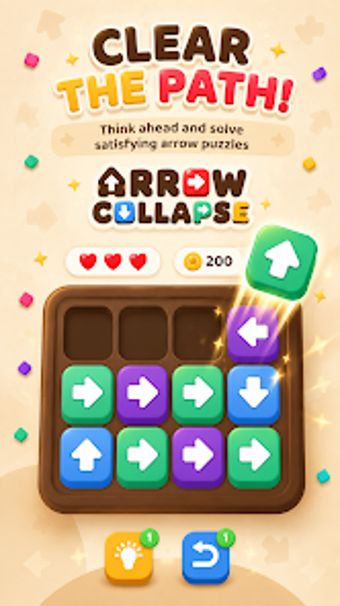
Minimal directional puzzle with collapsing tiles, smart sequencing on Android
Arrow Collapse, developed by Orelia, is an Android puzzle that tests sequential planning on compact tile grids. It centers on short, discrete levels where each move alters the board state and forces players to anticipate future positions rather than rely on repeated trial-and-error. Minimal 2D visuals and responsive feedback keep focus on logic, while levels gradually demand multi-step sequencing and precision and timing. It is designed for puzzle enthusiasts and casual players seeking brief, focused reasoning sessions on mobile devices.
How do moves reshape the playing field?
In this game, successful actions change the puzzle landscape in two linked ways. An arrow can only depart when every intervening cell between it and the board edge is empty, and a tapped tile that leaves the grid causes the column above it to drop down. That vertical movement, called the collapse mechanic, converts single moves into branching consequences and requires thinking several turns ahead to avoid dead ends.
How steep is the learning curve for new players?
In this game, controls remain deliberately simple but strategy grows quickly. Levels introduce progressive difficulty that rewards sequencing rather than reflexes. The app includes utility options to soften the entry:
- Undo to revert recent moves
- Hints to reveal safe lines of play
What does the presentation and feedback contribute to play?
In this game, the visual and tactile design keeps attention on decision-making. Animations are smooth and arrow removals produce satisfying tactile feedback, while a clean, colorful interface reduces visual clutter. The layout and controls suit short sessions on Android devices and the title supports offline-friendly play, letting users run puzzles without a constant data connection.
How replayable is it, and what games does it resemble?
In this game, replay value comes from level design and sequencing challenges rather than randomized content. Progressive level sets ask for new ordering strategies, so players revisit stages to tighten solutions. The mechanic contrasts with static arrow puzzles because the board physically changes after each removal, creating emergent problems. The title has been noted for satisfying mechanics and a tidy presentation, earning positive attention among recent indie puzzle releases.
Who should pick it up and why
Arrow Collapse is a focused choice for players who enjoy compact, planning-heavy puzzles and short mobile sessions. However, its emphasis on single-player, level-based sequences means it does not cater to those seeking varied game modes or social play. For anyone who values careful sequencing and small, satisfying challenges, the design rewards patience and deliberate thinking.